Markets don’t sleep. Neither does your risk desk.
Dedicated 24/7 dealing and risk coverage: experienced professionals monitoring exposure, trader behaviour, execution and live brokerage risk.
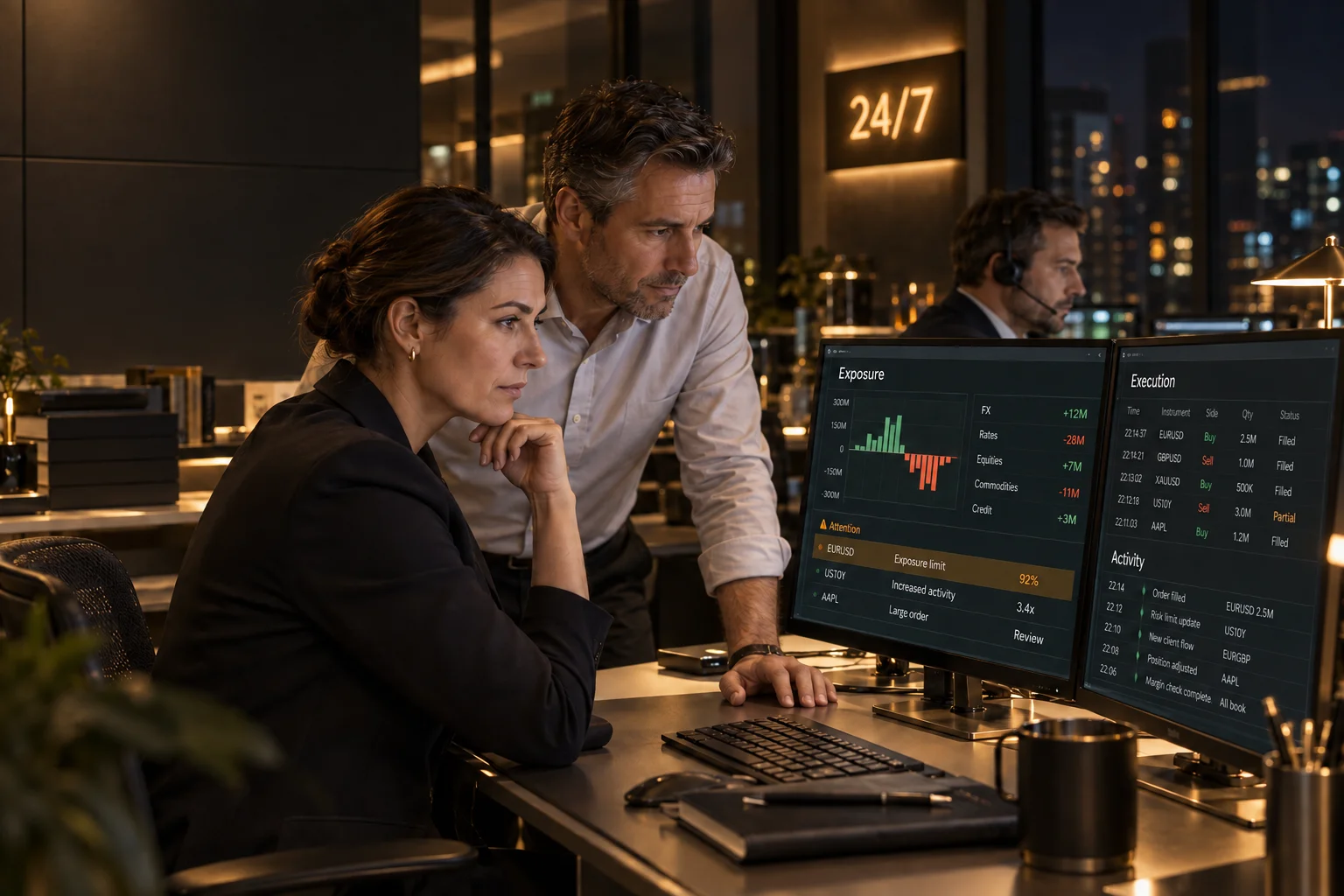
Continuous market coverage.
Human judgment where automation stops.
The desk combines live evidence with market context.
A/B Book Supervision
Dealers review allocation and net exposure continuously, checking whether configured routing still reflects current flow quality, concentration and the broker's commercial risk policy.
Trader Classification
Behaviour, consistency, latency sensitivity and trading patterns are assessed in context. Classification informs supervision and routing without reducing a trader to a single automated score.
Flow Monitoring
The team watches concentration, news-driven activity, execution anomalies and changing liquidity conditions across instruments, sessions and client groups.
Dealer Intervention
When rules cannot read the full situation, a dealer can investigate, restrict, escalate or coordinate a response under an agreed authority and documented decision process.
Hedging Recommendations
Dealers interpret exposure, available depth, timing and cost before recommending whether to hedge now, hedge partially, adjust routing or continue to hold risk.
A dealing process, not an alert queue.
Select a scenario to see which signals reach the desk, how a dealer handles them and what the outcome is.
News release
- 1The desk prepares for a scheduled release on the calendar
- 2Exposure builds on the affected symbols as clients position
- 3The dealer weighs depth, timing and cost before hedging
- 4The decision and reasoning go into the shift report
Unusual client flow
- 1A group's trading pattern changes or an alert fires
- 2The dealer reviews behaviour in context, not a single score
- 3The flow is classified against your policy
- 4Routing or restrictions change within the agreed authority
LP degradation
- 1Rejects rise or spreads widen on one LP
- 2The dealer checks whether it is market-wide or LP-specific
- 3Flow is moved to other sessions where configured
- 4The broker is informed and the incident logged
Signal, no action
- 1An automated alert fires on exposure
- 2The dealer finds it consistent with expected flow
- 3No intervention is made
- 4The reasoning is written into the shift notes
Reference process. Dealer authority, escalation thresholds and which actions need broker approval are agreed in writing per engagement.
Automation sees patterns. Dealers understand context.
A rule reacts to a number. A dealer reads the situation behind it — a news print, a thin session, a client whose behaviour changed this week, an LP quoting defensively. That judgment decides whether to hedge now, hedge partially, widen, restrict or wait.
How the coverage is structured.
Dedicated coverage
Named dealers who know your book, instruments and client base.
Shift-based operation
Continuous handover across sessions with written shift notes.
Escalation framework
Defined thresholds for when we act, when we consult and when we call.
Reporting
Session, daily and incident reporting on exposure and interventions.
Continuous monitoring
Supervision through every session, rollover and news event.
Two separate offerings. One risk environment.
| RiskMan | 24/7 Dealing Desk | |
|---|---|---|
| What it is | Automated risk-management software | Human-managed dealing service |
| Acts on | Rules you configure | Dealer judgment within agreed authority |
| Handles | Predefined, repeatable cases | Cases that need context or a decision |
| Engaged | Independently | Independently |
Each can be engaged independently. Together, automated processes handle the predefined cases and the desk handles everything that requires a decision.
Put an experienced desk on your book.
Explore Related Solutions
Explore Dealing Desk Research
Operator-level analysis supporting 24/7 dealing desk & risk management.