Forex IB Management: Multi-Level IBs, Rebates & CPA
Quick answer
Forex IB management is the system layer that records who introduced a client, keeps that relationship intact for the client''s lifetime, calculates partner compensation from real trading activity through a defined hierarchy, and produces statements and payouts that reconcile. Its quality is judged by attribution integrity and by whether a disputed figure can be reconstructed — not by the number of commission models on a feature list.
Contents
- IB architecture
- Attribution: the part that must not be wrong
- Commission models
- How a commission engine works
- The multi-level example
- The IB portal
- Operational risks
- Payouts and reconciliation
- FAQs
IB architecture
An introducing-broker structure is a hierarchy of commercial relationships that sits alongside the client hierarchy, and it needs to be modelled explicitly.
- Master IB. A partner at the top of a branch, usually with its own sub-partners and its own plan.
- Sub-IB. A partner introduced by, and reporting under, another partner, with a plan that may differ from its parent''s.
- Multi-level IB. Several tiers, where compensation can flow upward through the branch according to plan rules and depth limits.
- Referral relationship. The link between a client and the partner who owns them, with a start date, an end date where relevant, and a reason for any change.
Two design decisions matter more than the rest. First, partner records are not simply clients with a flag — a partner has a plan, a position in a hierarchy, a payout method and statements. Second, a client''s ownership must be a dated relationship rather than a field, because it changes, and every historical commission calculation depends on what was true at the time.
Attribution: the part that must not be wrong
Everything downstream inherits from attribution. If the wrong partner is credited at registration, no amount of commission logic will fix it, and the correction will be a manual adjustment somebody has to justify.
- Referral links. Partner and campaign identifiers captured at first touch and preserved through registration, including across devices where possible.
- Promo codes. A manual fallback for offline and community-led introductions, validated against active partners.
- Campaign attribution. Source, medium, campaign and landing page stored on the lead so partner performance can be read alongside marketing performance.
- Client ownership. One owning partner at any point in time, with an explicit rule for what happens when a client arrives through two channels — typically first-touch or last-touch, decided as policy and enforced by the system rather than settled case by case.
Attribution is captured at the top of the onboarding journey described in our forex CRM workflow guide, and it has to survive every stage after it.
Commission models
Most brokerages run several models at once, by partner segment and by instrument group. The engine, not the sales team, should decide which applies.
| Model | Basis | Typical use | What to watch |
|---|---|---|---|
| CPA | A fixed amount per qualified client | Media buyers and affiliate traffic | Qualification criteria — deposit size, verification, trading activity — must be unambiguous |
| Revenue share | A share of brokerage revenue from the client | Long-term partners | Definition of revenue, and how it behaves across A-Book and B-Book flow |
| Rebate | Per lot or per volume traded | Volume-driven partners and IB networks | Instrument and group differences; contract-size handling |
| Spread or markup based | A component of the spread or markup applied | Partners embedded in pricing | Interaction with your bridge markup and routing configuration |
| Hybrid | A combination, often CPA plus rebate | Partners moving from acquisition to retention | Clear precedence rules to prevent double payment for the same activity |
We do not publish commercial rates: plan economics depend on your instruments, spreads, risk model and market, and are set per brokerage. Permitted partner compensation also varies by jurisdiction — some regimes restrict or prohibit particular models for retail clients — so confirm which structures are allowed in your target markets before configuring plans.
How a commission engine works
A commission engine is a calculation pipeline over trading activity. Conceptually it runs in five steps.
- Collect activity. Closed trades, volumes, instruments, timestamps and revenue components read from the trading server — on MetaTrader 5 through the MT5 Manager API — for a defined period.
- Determine eligibility. Apply plan rules: which instruments and groups count, which client states qualify, minimum thresholds, exclusions for bonus or internal accounts, and any deduplication against previously paid activity.
- Calculate the base amount. Compute the owning partner''s entitlement for each eligible unit of activity under their plan.
- Allocate through the hierarchy. Walk upward from the owning partner, applying each tier''s plan and depth limits, so parent partners receive their defined share of the branch.
- Produce statements. Aggregate accruals into partner statements per period, with drill-down to the underlying activity, then move them through approval to payout status.
Three properties separate a dependable engine from a spreadsheet with a schedule: calculations are reproducible for a historical period, every figure traces back to the trades that produced it, and adjustments are recorded as explicit entries rather than edits.
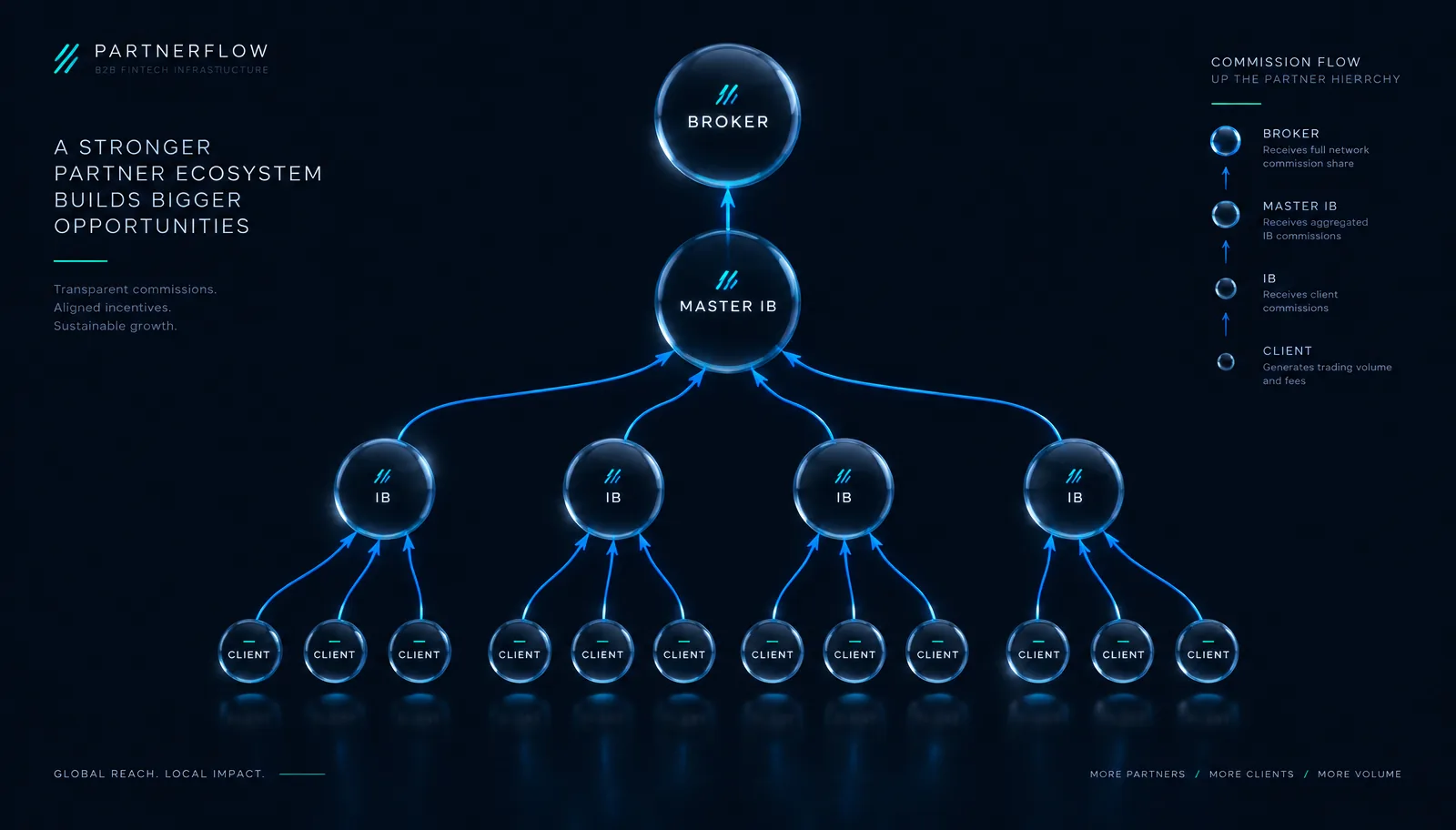
The multi-level example
-
Broker
Owns pricing, plans, eligibility rules and payout approval
-
Master IB
Receives its own plan on directly introduced clients, plus a defined share of its branch
-
Sub-IB
Holds client ownership and the primary plan on the activity it introduces
-
Client
Trading activity is the single source of every figure above
Attribution flows down from the broker; commission accrues upward from client activity, tier by tier, within plan and depth limits.
Read the diagram in both directions. Downward, it is ownership: the client belongs to the sub-IB, which belongs to the master IB''s branch. Upward, it is allocation: a closed trade produces an accrual for the sub-IB under its plan, then a branch share for the master IB, with the broker retaining the remainder. Depth limits stop the walk, and a client whose ownership changed mid-period is calculated against the relationship that was valid at the time of each trade.
The IB portal
Partners are business operators and need their own working environment rather than a monthly email. A useful portal gives them client visibility at the level your policy permits, performance data covering registrations, funding and activity, commission accruals with drill-down and statement history, referral tools including links, codes and campaign material, sub-IB management with the same visibility one level down, and payout status showing what is accrued, approved and paid.
Access scope is a policy decision with regulatory implications in some jurisdictions — decide deliberately how much client-level detail a partner may see, and enforce it in the system.
Operational risks
| Risk | How it appears | Control |
|---|---|---|
| Duplicate attribution | Two partners claim the same client | One dated owning relationship, enforced first-touch or last-touch policy, and audited overrides |
| Incorrect plan configuration | Overpayment or underpayment discovered later | Plan versioning, effective dates, review before activation and a test calculation before first payout |
| Poor reconciliation | Accruals do not agree with platform activity or payments made | Period close with a reconciliation step between platform data, accruals and payouts |
| Missing audit trail | A disputed statement cannot be reconstructed | Append-only records of activity, calculation runs, adjustments and approvals |
| Overlapping ownership | Sub-IB moved between branches, historical figures shift | Dated hierarchy edges so historical periods recalculate against the structure of the time |
| Inadequate reporting | Partner quality is unknown; incentives misfire | Cohort reporting on funding rate, activity and retention by partner, not volume alone |
Payouts and reconciliation
Payout is the point where partner management meets treasury. The workflow needs a defined period close, statement approval by someone other than the person who configured the plan, a payout method per partner with its own verification requirements, and a record linking each payment to the statement it settles — the operational half of which sits with your banking and PSP infrastructure. Partner payouts also carry AML and record-keeping obligations in most jurisdictions, so treat them with the same discipline as client withdrawals rather than as a marketing expense.
Partner fraud and anti-abuse controls
An IB programme pays for referred trading activity, which makes it a target for abuse. The patterns every broker should design against:
- Self-referral. A trader registers under their own partner link to harvest rebates. Controls: device and payment-instrument fingerprinting, IP and behaviour correlation, and terms that void commissions on self-referred accounts.
- Rebate churning. Referred accounts trade in circles — often hedged across brokers — purely to generate commission volume. Controls: minimum trade-duration and volume-quality rules, spread-cost versus commission ratio monitoring, and clawback clauses.
- Multi-account networks. Coordinated account clusters under one partner to exploit tiered commission rates. Controls: network-level analysis in the commission engine rather than per-account checks.
- Commission on abusive flow. Latency arbitrage or bonus-abuse flow referred deliberately. Controls: excluding flagged trading behaviour from commissionable volume, with the rules stated in the partner agreement.
The common thread is that detection belongs in the commission engine and the trade data, not in manual review. A partner programme that calculates commissions in spreadsheets has no defence against any of these patterns, because the evidence is never assembled in one place.
Partner KYC and compliance
Partners are distribution, and regulators increasingly treat them that way. A partner programme needs its own onboarding discipline: identity and business verification for partners before activation, marketing-conduct terms that prohibit misleading promotion, and jurisdictional rules that restrict which partners can refer which clients. Where the brokerage is licensed, partner marketing may be attributable to the broker itself — an IB running non-compliant ads can become the broker's regulatory problem. Periodic partner review, like periodic client KYC review, should be a queue in the back office rather than an annual email. The operational side of these queues is covered in forex back office software.
FAQs
How many IB levels should we support?
Support depth in the system, but limit it by plan. Deep hierarchies are common in network-led markets, and unlimited depth without a plan-level limit makes economics hard to control and statements hard to explain.
Can commission be calculated in real time?
Accruals can be updated continuously from trading activity, which is what partners want to see in a portal. Payable amounts should still be fixed at period close, after eligibility rules and adjustments are applied.
What happens when a client changes partner?
The relationship should be closed with an end date and a new one opened, so past periods continue to calculate against the previous owner. Retroactive reassignment is the main cause of unexplainable statements.
Can we run CPA and rebates for the same partner?
Yes, and hybrid plans are common. The requirement is explicit precedence and deduplication rules so the same activity is not paid twice under two models.
Where this sits in our work
Partner hierarchies, attribution, commission calculation and the partner portal are part of our Forex CRM and IB infrastructure, with API access where commission data has to reach your own reporting or finance systems.
Related Research
Operator-level analysis supporting forex crm.
Take this from research to build.
Our team builds and operates forex crm for brokers and prop firms.